


 Facebook
 Reddit
"They're still not sure it is a baby."
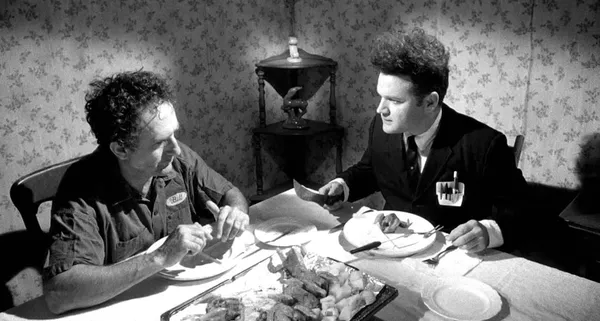
Not the words a new father most wants to hear - and Henry has only had moments to get used to the idea of being a father at all. Now his girlfriend is yelling at him, on the verge of walking out; his beautiful neighbour is trying to seduce him; he's having increasingly disturbing dreams; and the mutant infant who shares his room just won't stop crying.
 Eraserhead was David Lynch's first feature length film, and it's the real thing: raw, uncompromised, more visceral than anything he's done since. Lynch also composed the startling soundtrack, which was enormously important in the development of the industrial music genre. Henry's world is grim, black and white, industrial. There are pipes everywhere (all apparently fitted by his girlfriend's unhinged father) and the walls are crumbling. There's an intense sense of claustrophobia. Eraserhead is no ordinary film - it's a complete sensory experience which will haunt you for years to come.
There's lots here for fans of Lynch's later work to spot. The Lady in the Radiator who reassures Henry in increasingly bizarre dream-like sequences seems like a precursor of Twin Peaks' Girl Singer, whilst Man in Planet, who appears as the boundaries between fantasy and reality break down further, is like an early version of BOB. The screaming baby who dominates Henry's world is played by Lynch's own daughter, Jennifer, future director of Boxing Helena and the future 'auto'biographer of Laura Palmer. Jack Nance, the film's stalwart and eerily convincing star, has appeared in almost everything David Lynch has gone on to create.
Eraserhead is a study of freaks by somebody who knows what it's like to be one, or to be treated as one. Deeply sympathetic even in moments of potent horror, it's also a study of the nightmare side of parenthood and the desperate isolation that goes with it. Unlike in The Elephant Man, there is no 'normal' character here to translate for the audience. Instead of seeking to explain Henry in our terms, the film forces us to look at life on his, even as his insanity builds toward crisis point.
A truly unique piece of filmmaking.
Reviewed on: 11 Sep 2008

If you like this, try:
Review preview for Gozu
It comes across like a Japanese version of Performance, with all that studied oddity, sexual mutability, and narrative uncertainty.
Review preview for Inland Empire
Imagery and sound are so closely wedded throughout that at times it seems meaningless to distinguish between the two.
Review preview for Mulholland Drive
Lynch creates unease with every camera angle and glitch in the storyline.